This is an installment of Bryant Backyard Border Bouncing (BBBB). For more information, please see the bottom of the About page.
I failed a bit on this report, as we learned about Ethiopia in January, though I’m just now in May catching up. We also didn’t study it as extensively as I’d like, as we had a busy weekend. So therefore, it’ll be a short one!
I was very excited when Ethiopia was pulled from the hat, as I have worked with several people from the country both in the hotel and airline industry, and they’ve been some of the warmest and kindest people I’ve ever met. Also, I love the food! While I’ve made Ethiopian food at home before, I’ve never found it to be nearly as good as what’s found in local restaurants, with a big part of that being that some of the main seasonings and spices used are not found in stores, but are instead made at home using long, involved processes.
As always, I had the girls find Ethiopia on a map. The oldest is getting to know the globe better, so with a few hints, she found it herself! While we didn’t find any books at the library, I did find some facts about the country that I shared with the kids.
- The official language is Amharic, though there are 286 languages spoken by 86 ethnic groups!
- Famine and drought are huge problems, with over seven million people not having enough food, and as a result, life expectancy is very low.
- Teff, the grain used to make the staple bread of Ethiopia, called injera, is believed to have originated in the country between 4000BC and 1000BC.
- Some animals in the country include camels, elephants, and baboons.
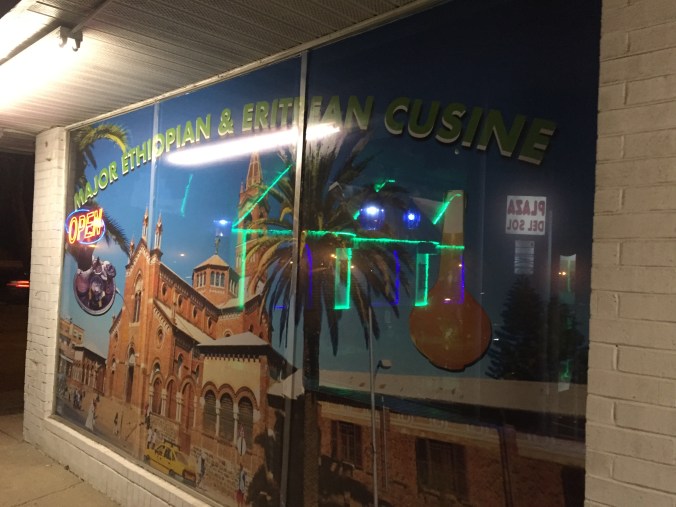
On a cold night in January, we visited Major Restaurant, located less than 15 minutes from our house on the west side of Indianapolis. We were happy to see another family there enjoying a meal. Always nice to see other parents exposing their kids to different cultures! As an appetizer, we ordered sambussa, which are thin shelled pastries stuffed with beef, chicken, and lentils. They were served with two sauces, both of which were delicious, though too spicy for anyone but me. For dinner, we ordered a combination plate that included two kinds of meats, along with salad, collard greens, two types of lentils, and cabbage.


I taught the girls that in their culture, it is custom to eat with one’s own right hand, using the injera (thin, soft, spongy bread made with a sourdough base) to scoop up each bite. We also learned that “gursha” is an act of friendship and love, and is when a person used their hand to strip off a piece of injera, wrap it around food, and place it in someone’s mouth. We girls were big fans of this.


While we didn’t do nearly as much with Ethiopia as we have with other countries, we really enjoyed learning what we did, and found that Ethiopian is a food that they’ll tolerate some of, which is a win, as dad loves it!
 Bryant Boondoggles